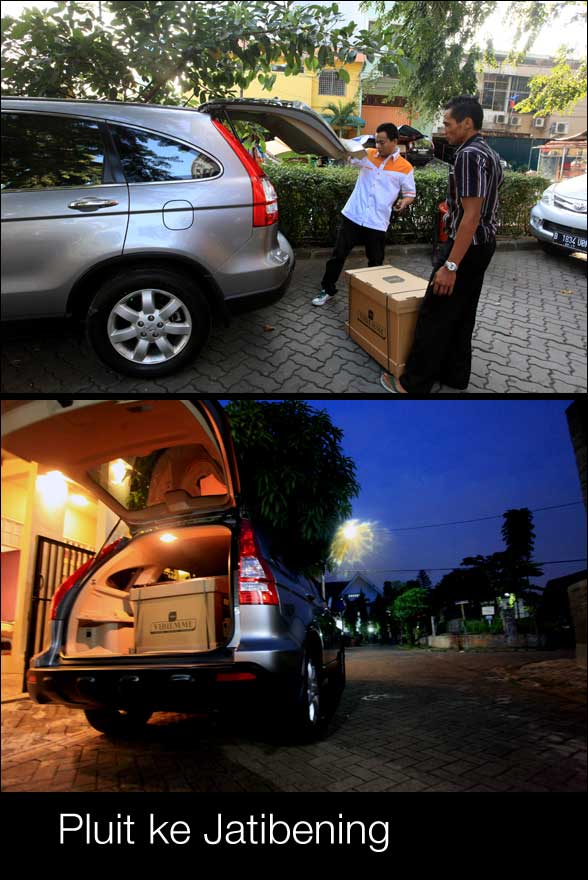
Two years ago, I wrote about unboxing a Vibiemme espresso machine, which you can read
here.
And now, the machine which is produced under the same brand but
equipped with more features and called as Vibiemme Double Domobar Manual
Stainless Version 3 is going to be a permanent resident at my crib.
Just think of it as a present from Vibiemme Italy and its Indonesian
distributor, Toffin, for Cikopi.com’s fourth year anniversary!
 Image 2: The Whole Package. Single and double portafilters, a
blind filter, a plastic tamper, a cleaning brush, a coffee spoon and a
manual. There’s also a flexi pipe to connect the machine to a water
supply, and a hose for water waste.
Image 2: The Whole Package. Single and double portafilters, a
blind filter, a plastic tamper, a cleaning brush, a coffee spoon and a
manual. There’s also a flexi pipe to connect the machine to a water
supply, and a hose for water waste.
This is the third version of Vibiemme, when previously it has released similar types of machines that I’ve reviewed, titled
Domobar PID & Double Boiler.
So I won’t bother you with too many unnecessary details, except for the
significant differences such as the changes in its pump, which
previously worked using a vibration method, and now has been modified
into rotary instead, as what you can find on any commercial machines.
Other upgrades include its ability to choose its water tank or water
supply by using a lever on the bottom of the machine. Vibiemme also
claims an important improvement on the consistency of the boiler
temperature and a steamer that is more powerful than its predecessor.
 Engineering and Design Aspects.
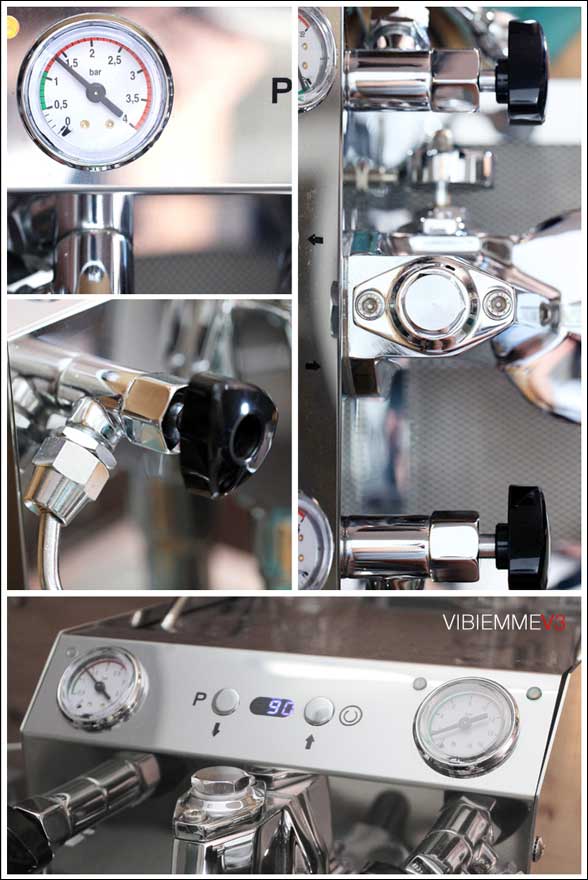
 Vibiemme’s exterior
design, which is intended for home appliance or light commercial use,
has not changed a lot since it was first released in the 80s. Made of
shiny stainless steel with a legendary E61 grouphead, its classic look
still remains a favorite to its fans. Look at the curves on its surface,
from top to bottom, you can see that Vibiemme pays a lot of attention
to details, making it one of those machines that will remain famous in
the world of espresso machines.
One thing that needs to be considered is even though a stainless
surface looks prestigious; it requires a lot of attention to keep it
that way. Overlooked water droplets can quickly stain and create dull
spots on its surface – think about maintaining the surface of a car in
metallic black and you’ll know how much of a pain it can be. If you
can’t be bothered to polish it regularly using a micro fiber rag, dirt
and droplets will soon become permanent decorations of the exterior.
 Features and Specs:
The Package:
Features and Specs:
The Package: Inside the cardboard, you’ll find a
single and a double portafilter, a blind filter for backflushing, a
cleaning brush, a plastic tamper, a manual and hoses for water supply
distribution and waste. As usual, the plastic tamper is merely a
formality, so to tamper coffee on a 58 mm portafilter, use an aluminum
or stainless one instead.
Electricity power: Lifting a machine that weighs
around 31 kg in total requires the ability of two grown men, and the
machine must be placed on an even and strong surface. The length reaches
53 cm and its width is 27 cm, with the height of 42 cm and takes up the
total power of 2100 watt which is divided for brewing (which takes up
900 watt) and steaming (which takes up 1100 watt).
Power source can be an obstacle for any home barista, who usually has
to supply an extra power source to meet the machine’s needs. The good
thing about this machine is that it doesn’t use a 3-phase system, so
your home electricity can be fairly distributed with a miniature circuit
breaker or MCB. As a side note, the large electricity power on this
machine requires prime quality electricity outlets or power supply which
is necessary for safety and short-circuit prevention.
 Water tank:
 The machine cover can be opened and
closed to access the 1.8 liter water tank which has a small hole to
adjust the Pressure Stats using a flat-blade screwdriver. The water tank
can also be detached not only for easy refilling, but also quite handy
should you need to change the water supply to direct plumbing, which can
be tightened using a Phillips screwdriver.
Tightening the screws is meant as a bypass, so that the automatic
shutdown feature, so in case the water tank is empty, the machine
automatically turns of its electrical flow to protect itself from any
heat from the boiler due to insufficient water supply. If you’re using
other brands who do not have this feature, it is advised that you check
the water supply frequently so fatal damage on important parts – such as
the heating element – can be avoided.

When closed, the top part can be used to store or warm up your coffee
cups, and this is done by using the heat from the boiler. As an
additional feature, some double grouped commercial machines use an
activated warming system which is basically a heating element placed on
the cover’s surface – like Vibiemme Lollo, for example. It’s a useful
feature nonetheless, since it’s advisable that you keep your cups warm,
to prevent the coffee’s temperature dropping drastically due to any
contact with cold equipment.
The Front Panel: Two manometers show the boiler
pressure indicator (on the left) and the pump’s (on the right), which
are important to monitor while brewing. The manual does not tell you
exactly how much is the pressure for the pump and the boiler, but on the
previous machine I used, 8.6 to 9.2 bars for the pump pressure is the
safe range, as advised by the manufacturer.
There’s a steam wand on the right hand side, and a movable steam with
two holes – each has 1 mm diameter – are placed on the left. The steam
wand produces heat when the machine is operated because it’s not
equipped with an anti-burn feature. You can find the hot water lever on
the right hand side, which I rarely use.
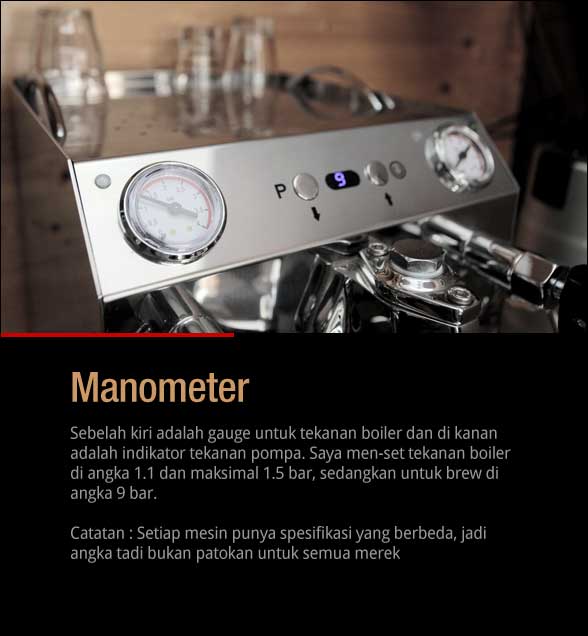
 The Manometer. On the left is a gauge for boiler pressure and on
the right is a pump pressure indicator. I set the boiler pressure to 1.1
and to a maximum 1.5 bar, and 9 bar for brewing.
Double boilers and a rotary pump
The Manometer. On the left is a gauge for boiler pressure and on
the right is a pump pressure indicator. I set the boiler pressure to 1.1
and to a maximum 1.5 bar, and 9 bar for brewing.
Double boilers and a rotary pump: This third version
of Vibiemme is equipped with two 500 ml boilers to brew coffee, and 1.9
liter for steaming purposes. The boiler is specially coated to keep the
water temperature stable. The rotary pump is attached on the back of
the boiler – a common feature for commercial, double-grouped machines.
In the manual, it says that the pump is not designed to support water
that flows against gravity – so basically, you need to use an additional
pump – like a flo jet – if you want to utilize a water gallon under the
cabinet.
 The Cup Warmer. With the dimension of 26 x 25 cm, it’s enough to warm several cups, as pictured above.
PID:
The Cup Warmer. With the dimension of 26 x 25 cm, it’s enough to warm several cups, as pictured above.
PID: This is the selling point for Vibiemme V3. PID
is an abbreviation for Proportional, Integral and Derivative; it allows
brewing temperature setting to accommodate the operator’s needs. The
temperature parameter is adjustable – Celsius or Fahrenheit – by
pressing both buttons when the machine is off. While both are pressed,
turn the switch to the “I” position so the display shows “F.03”, and
then release them. Adjust the “C” or the “F” by pressing the button on
the right hand side, and when you’re done, turn the machine off to
execute the command, and then turn it back on.
The PID feature is adjustable to even the lowest temperature, which
is 80°C to the highest, which is 125°C. So what is the ideal brewing
temperature? For me, 95 to 98°C is sufficient, but then again it goes
back to the machine’s operator to adjust the temperature as needed.
Additionally, the manufacturer claims that when the machine is idle or
when it is on but not used, the temperature will automatically drop to
1°C.
 The Shower Screen. This part must always be looked after its
cleanliness, since the remaining of brewed coffee usually precipitates
here.
Operating V3
The Shower Screen. This part must always be looked after its
cleanliness, since the remaining of brewed coffee usually precipitates
here.
Operating V3
For my convenience, I use the water supply from the machine’s 1.5
liter capacity water tank. Like I said before, when the water in the
tank has run out, Vibiemme will automatically shut itself down to
prevent overheating from the boiler due to insufficient water supply,
which in turn can cause damage. If that’s the case, simply switch it on
by moving the lever to the “I” position and the pump will start drawing
water into the two boilers, which takes only less than a minute. To make
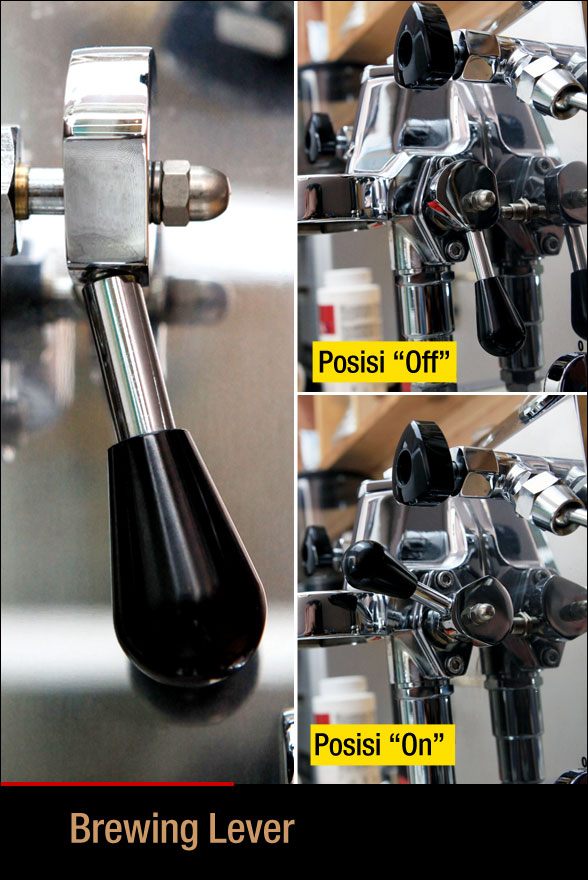
sure that the water is in there, I lift the brewing lever and flow
water into the grouphead – an initial process called priming. Next, I
move the power switch lever to “II” and the heater will start working
which is shown by the temperature indicator gradually increasing. It can
be adjusted by pressing the “P” button. 20 minutes of all that and
Vibiemme is all yours to use.
 Pressure Adjustment:
 This process requires changing
the boiler pressure parameter and pump by a preinitial test using the
blind filter. Check the pump and boiler pressure shown on both manometer
while lifting the brewing lever. I did this with the cover open so I
could access both parts from the machine – which are the pump and the
P-stats. I only change the pump pressure to bar 9, a moderate number
that usually works for espresso extraction especially for home
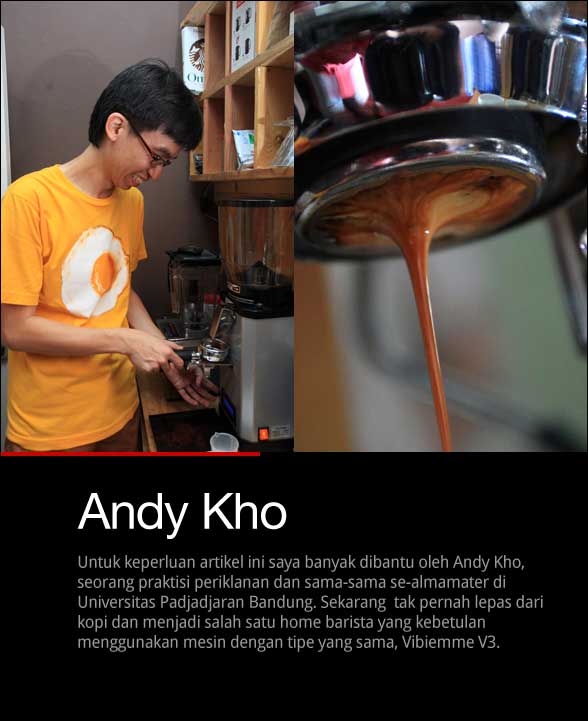
appliances. My thanks to Andy Kho who was kind enough to share his home
barista knowledge while tweaking the V3 machine.
Brewing: A good grinder will definitely compliment a
V3, and Anfim Caimano On Demand is the brand that we chose as its
partner in crime. Andy and Hideo who coincidentally brought fresh coffee
with them tried VST 7 basket and 22 gram attached to Vibiemme’s
portafilter. The extraction result made by two home baristas, Andy Kho
and Anto who came several days later, can be seen below. Especially for
steaming, the machine – which has 2 liter boiler capacity – is able to
froth with all its might within 5-7 seconds on a 300 ml pitcher.
 Conclusion:
The Vibiemme V3 – just like its predecessor – is always a pleasure to
use, as it is a machine that has a renowned reputation in the world of
espresso machines. But of course, just like us humans, no machines are
100% perfect – there are always one or two things that could have been
better, like the brewing lever which I personally think is too close
with the E61 grouphead. Of course, you must understand that due to the
limited constructions, you have to watch your hands more carefully to
avoid being scalded by the hot grouphead. Every now and then, flushing
must be executed, especially when the machine is idle – this is to
reduce the heat accumulated within the group head. Putting all those
things aside, this is basically a glance of how we use the V3 machine,
and of course revisions will be added when we do find further
information, along with further usage.
Last but not least, I would like to thank Vibiemme and Toffin for
their kind attention and appreciation for Cikopi.com, and this machine
will definitely be my favorite partner in crime in my coffee lab.
Cheers!
* * *

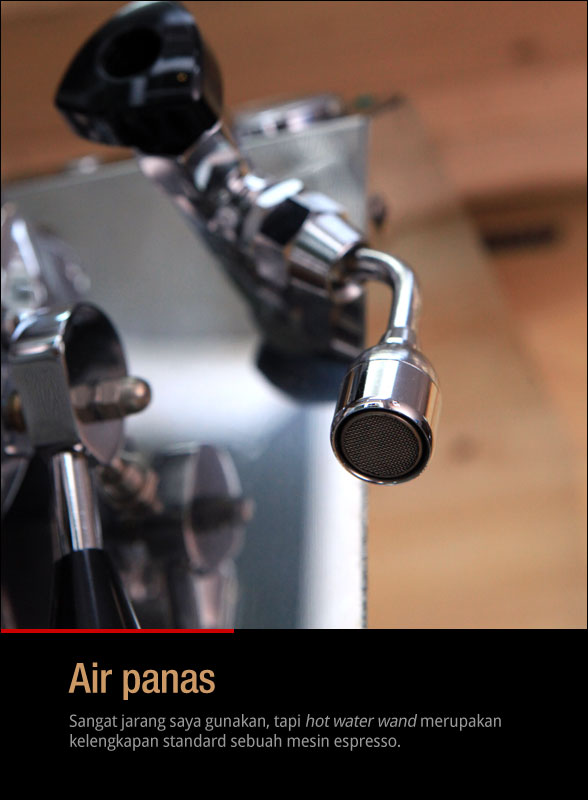
 Hot water wand : When you want it hot. I rarely use this feature, but the hot water wand is a standard feature for an espresso machine.
 The Pressure Adjustment. Always remember that
Vibiemme advises 8.6 to 9.2 bar for the pump boiler. The first step is
to definitely take all the panels off to have full access to the pump.
The Pressure Adjustment. Always remember that
Vibiemme advises 8.6 to 9.2 bar for the pump boiler. The first step is
to definitely take all the panels off to have full access to the pump.
 Two Water Sources. You can either get it from
the left hose, or the water tank within the machine which functions can
be adjusted by rotating the lever on the right. This feature is
accessible at the bottom part of the machine.
Two Water Sources. You can either get it from
the left hose, or the water tank within the machine which functions can
be adjusted by rotating the lever on the right. This feature is
accessible at the bottom part of the machine.
 The Water Tank. With the capacity of 1200 ml,
there’s an automatic shutdown feature, which means the machine shuts
down automatically when the water supply is empty, in order to prevent
damage from the heater in the boiler. The yellow tab with the plus and
minus symbol on its sides is an access to change the pressure stats – or
also known as the boiler pressure.
The Water Tank. With the capacity of 1200 ml,
there’s an automatic shutdown feature, which means the machine shuts
down automatically when the water supply is empty, in order to prevent
damage from the heater in the boiler. The yellow tab with the plus and
minus symbol on its sides is an access to change the pressure stats – or
also known as the boiler pressure.
 The Rotary Pump. This is the heart of every
espresso machine. It distributes water into the boiler and the group
heads. The part highlighted in red can be tweaked to change the pump
pressure.
The Rotary Pump. This is the heart of every
espresso machine. It distributes water into the boiler and the group
heads. The part highlighted in red can be tweaked to change the pump
pressure.
 The P-Stats. The pressure stats, which is used
to set the boiler pressure, can be adjusted as needed. I didn’t make any
adjustment to it – 1.1 bar was powerful enough to steam milk.
The P-Stats. The pressure stats, which is used
to set the boiler pressure, can be adjusted as needed. I didn’t make any
adjustment to it – 1.1 bar was powerful enough to steam milk.
 The Power Switch. : O = off. I = the pump fills
up water, while the heating gets warmed up, II = The heater starts
working inside the boiler. First, slide it to the “I” position – if the
water has filled up the boiler and the pump has stopped working, slide
it over to the “II” position and wait until the machine is ready to
use. This is the mechanism that is meant to protect the machine from the
heating element due to insufficient water supply in the boiler.
The Power Switch. : O = off. I = the pump fills
up water, while the heating gets warmed up, II = The heater starts
working inside the boiler. First, slide it to the “I” position – if the
water has filled up the boiler and the pump has stopped working, slide
it over to the “II” position and wait until the machine is ready to
use. This is the mechanism that is meant to protect the machine from the
heating element due to insufficient water supply in the boiler.
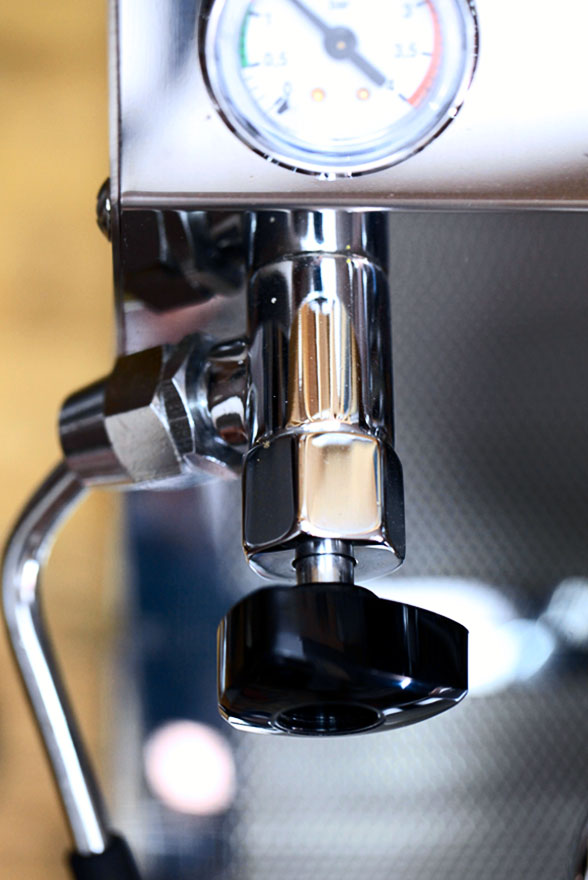
 The OPV – which stands for Over Pressure Valve –
or as I call it, “Expansion valve” – which expels any overflowing
pressure. For example if there’s any accumulated pressure on the
grouphead due to over extraction (over-refined ground coffee) will be
expelled from the OPV pipe with a hissing sound.
The OPV – which stands for Over Pressure Valve –
or as I call it, “Expansion valve” – which expels any overflowing
pressure. For example if there’s any accumulated pressure on the
grouphead due to over extraction (over-refined ground coffee) will be
expelled from the OPV pipe with a hissing sound.
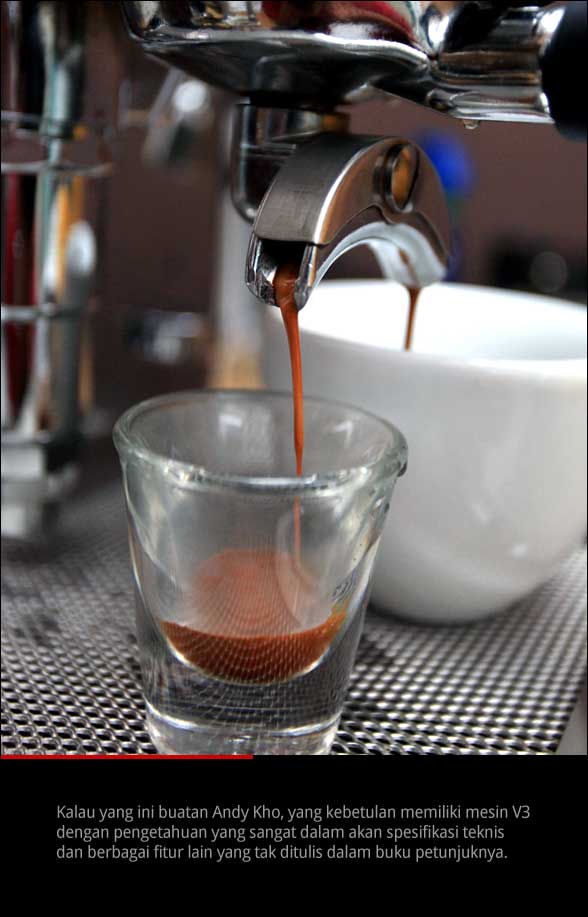
 This is Andy Kho’s creation, who happens to own a V3 and knows
the machine so well, including its technical specification and other
features not written on the manual.
This is Andy Kho’s creation, who happens to own a V3 and knows
the machine so well, including its technical specification and other
features not written on the manual.
Semoga pembaca masih ingat bahwa dua tahun yang lalu saya pernah mempunyai mesin espresso Vibiemme yang saya
unboxing di
sini. Untuk kali kedua mesin dengan merek yang sama namun berbagai fitur tambahan yang nama lengkapnya :
Vibiemme Double Domobar Manual Stainless Version 3 akan
menjadi penghuni tetap di rumah saya. Katakanlah sebagai kado dari
Vibiemme Italia dan distributornya di Indonesia Toffin akan usia blog
kopi ini yang menjelang 4 tahun !
Ini versi ke-3 setelah sebelumnya Vibiemme mengeluarkan tipe yang sama yang pernah saya tulis dalam artikel dengan judul
Domobar PID & Double Boiler.
Jadi saya tidak akan terlalu detail mengulas kecuali beberapa perbedaan
signifikan seperti penggantian pompa yang pada versi terdahulu
menggunakan tipe
vibrasi menjadi
rotary sebagaimana yang biasa terdapat pada mesin komersial.
Upgrade yang
lain meliputi kemampuan versi ini untuk memilih tangki air atau
sambungan langsung ke sumber air dengan perpindahan satu tuas di bagian
bawah mesin. Vibiemme juga mengklaim penyempurnaan penting pada
konsistensi suhu boiler dan
steam yang lebih bertenaga dibanding tipe terdahulu.
Rancang bangun dan desain. Desain eksterior untuk mesin Vibiemme yang biasa digunakan untuk rumahan atau hanya
light commercial tak banyak berubah sejak pertama kali diperkenalkan di awal tahun 80an. Berbalut
stainless yang mengkilap dengan
group head legendaris
tipe E61 dengan tampilan klasik yang tetap mempunyai banyak penggemar
setianya. Lihatlah setiap lekuk permukaannya dari atas hingga ke bawah,
attention to details, yang membuat mesin dengan
group head E61 seperti tak hendak segera hilang dari jagat mesin espresso.
Satu hal,
Stainless memang mengkilap dan enak dipandang,
tapi menyisakan sedikit ketaletenan untuk tetap membuatnya selalu
berkilau. Sisa-sia air yang menempel dan lupa dibersihkan akan cepat
membekas lalu membuat bercak kusam di permukaannya. Sebagaimana mobil
berwana hitam metalik, bila tak rajin
dipoles dengan lap
microfiber, kotoran akan menjadi penghuni tetapnya.
Spesifikasi & Fitur :
Kelengkapan : Dalam kardus Vibiemme V3 kita akan mendapatkan masing-masing satu buah
portafilter single dan
double, blind filter untuk keperluan
backflush,
sikat pembersih, tamper plastik, buku petunjuk, dan selang untuk
distribusi air bersih dan kotor. Sebagaimana biasa, sisihkan tamper
plastik dan gunakan yang terbuat dari aluminum atau
stainless yang bisa menekan kopi pada portafilter ukuran 58mm.
Daya listrik : Mengangkat sebuah mesin yang berat
total berserta kardusnya sekitar 31 kg tentu memerlukan dua orang dewasa
dan harus ditempatkan pada permukaan yang rata serta kokoh. Panjangnya
mencapai 53cm dengan lebar 27 cm dan tinggi 42 cm serta akan
menghabiskan total daya listrik 2100 watt yang dibagi untuk
brewing sebesar 900 watt dan 1100 untuk
steam.
Besarnya daya listrik seringkali menjadi kendala bagi para
home barista yang
harus menyediakan suplai listrik tambahan demi memenuhi kebutuhan mesin
ini. Bagusnya tidak menggunakan sistem 3 phase, jadi pendistribusian
lsitrik di rumah bisa diseimbangkan sedemikian rupa melalui
miniature circuit breaker (MCB).
Sebagai catatan, daya listrik yang besar pada mesin Vibiemme memerlukan
peralatan yang berkualitas prima terutama untuk outlet atau sumber
listrik demi keamanan dan pencegahan arus pendek.
Air galon atau tangki : Penutup atau cover mesin
bisa dibuka tutup untuk mengakses tangki air yang berkapasitas 1,8 liter
serta satu lubang kecil untuk memasukan obeng (-) saat kita akan
mengubah
Pressure Stats atau tekanan di dalam boiler. Tangki
air bisa dilepas bukan saja untuk kemudahan pengisian, tapi terdapat
satu sekrup kecil (+) yang harus dikencangkan bila pengguna ingin
mengubah sumber air ke
direct plumb. Pengencangan sekrup dimaksudkan untuk mem-
bypass agar fitur
“automatic shutdown”,
dimana saat tangki air kosong mesin secara otomatis akan mematikan
sambungan ke listrik untuk melindungi kerusakan elemen pemanas di boiler
karena kekurangan pasokan air. Tentu saja mesin merek lain yang tidak
memiliki fitur seperti ini diharapkan untuk rajin-rajin melihat suplai
air di tangki sehingga kerusakan fatal bagian penting seperti
heating element bisa dihindari.
Bila sudah ditutup kembali, bagian atas selalu digunakan untuk
menyimpan dan menghangatkan cangkir yang dihasilkan dari udara panas
boiler. Sebagai tambahan, pada beberapa mesin komersial dua group banyak
digunakan sistem penghangat aktif yakni sebuah heating element ditempelkan di bawah permukaan cover-nya
(Vibiemme Lollo misalnya). Cangkir yang akan digunakan memang
disarankan atau lebih tepatnya diwajibkan untuk selalu hangat,
setidaknya untuk mengurangi penurunan suhu kopi yang drastis akibat
peralatan dingin.
Panel depan : Dua manometer yang menunjukan
indikator tekanan boiler (kiri) dan pompa (kanan) adalah hal penting
yang harus diperhatikan setiap melakukan
brewing. Buku petunjuk
tidak memberikan berapa besar tekanan pompa dan boiler, tapi pada mesin
yang saya miliki dulu, 8.6 hingga 9.2 bar adalah angka aman yang
dianjurkan oleh pabrikan untuk tekanan pompa.
Satu buah
steam wand di bagian kanan dan
steam yang bisa digerakan secara bebas dengan dua lubang ukuran 1 mm diletakan di bagian kiri.
Steam wand menghasilkan panas saat mesin dioperasikan karena tidak dilengkapi dengan fitur
anti burn. Tuas air panas berada di sebelah kanan yang snagat jarang saya gunakan.
Dual Boiler & Pompa Rotary : Versi tiga
Vibiemme dilengkapi dengan dua buah boiler masing-masing berukuran 500
ml untuk menyeduh kopi dan 1.9 liter untuk keperluan
steam. Boiler diberi lapisan khusus untuk menjaga suhu air tetap stabil.
Pompa
rotary terpasang di bagian belakang boiler, sebuah kelengkapan yang biasa terdapat pada mesin komersial dua
group.
Vibiemme dalam buku petunjuknya menyatakan bahwa pompa ini tidak
didesain untuk mengalirkan air melawan gravitasi, dengan kata lain
mereka ingin mengatakan agar menggunakan pompa tambahan seperti
flo jet bila memanfaatkan galon air yang dipasang di bawah kabinet.
PID : Nah ini fitur yang menjadi selling point Vibiemme V3, sebuah istilah yang dikenal dengan Proportional, Integral, Derivative, yang memungkinkan pengaturan suhu seduh atau brewing sesuai dengan kebutuhan pengguna. Parameter suhu bisa diubah, baik menggunakan sistem celsius atau fahrenheit dengan menekan kedua tombol pada saat mesin dalam keadaan tidak menyala. Sambil terus menekan kedua tombol, putar switch ke
posisi “I” hingga display menunjukan “F.03″ lalu lepaskan. Atur “C”
atau “F” dengan menekan tombol pada bagian kanan, setelah selesai
matikan mesin sebagai eksekusi perintah lalu nyalakan kembali.
Fitur PID bisa diatur pada suhu terendah yakni 80 derajat C hingga
tertinggi sebesar 125 derajat C. Berapa suhu seduh yang ideal ? Untuk
saya angka 95 hingga 98 derajat C sudah cukup memadai, tapi tentu
terserah kepada pengguna untuk mengatur suhu sesuai dengan kebutuhan.
Sebagai tambahan, pabrikan mengklaim bahwa perubahan suhu pada saat idle atau mesin yang menyala tapi tidak dioperasikan lalu digunakan hanya berkisar 1 C.
Menggunakan V3
Untuk kepraktisan saya menggunakan sumber air yang terdapat di dalam
mesin dengan mengisinya sebanyak 1.5 liter. Sebagaimana yang sudah saya
katakan di atas, saat air di dalam tangki kosong maka secara otomatis
Vibiemme mematikan sistem kelistrikan untuk mencegak kerusakan pada
bagian pemanas di dalam boiler akibat kekurangan pasokan air. Lalu
tomobo power dinyalakan dengan memindahkan ke posisi “I” dan pompa mulai
menarik air ke dalam dua boiler yang berlangsung kurang dari satu
menit. Untuk memastikan air sudah berada di dalam boiler saya mengangkat
tuas
brewing dan mengalirkan air ke dalam
group head untuk pertama kali, sebuah proses yang dinamakan
priming. Selanjutnya pindahkan
switch power ke
posisi “II” dan pemanas akan mulai bekerja beserta indikator suhu yang
perlahan naik sesuai dengan suhu yang bisa diatur dengan menekan tombol
“P”. Hanya sekitar 20 menit Vibiemme V3 sudah siap digunakan.
Pressure Adjustment : Tapi tahan dulu, bila Anda ingin melakukan
pressure adjustment ini saatnya yakni mengubah parameter tekanan boiler dan pompa dengan melakukan test terlebih dahulu menggunakan
blind filter. Lihat tekanan pompa dan boiler yang ditunjukan pada kedua manometer sambil mengangkat tuas
brewing. Proses ini saya lakukan dengan membuka
cover hingga
bisa mengakses kedua bagian tersebut, yakni pada pompa dan P-Stats.
Hanya tekanan pompa yang kami ubah menjadi 9 bar, angka moderat yang
biasanya
tokcer untuk ekstraksi espresso pada mesin rumahan. Terima kasih kepada Andy Kho yang sudah berbaik hati berbagi ilmu
home barista-nya saat melakukan
tweak pada mesin V3.
Brewing : Grinder yang baik tentu akan membuat V3
mengeluarkan segenap kemampuannya dan Anfim Caimano On Demand kami
gunakan untuk mendampingin mesin ini. Andy beserta Hideo yang kebetulan
membawa kopi yang masih segar bugar mencoba basket VST 7 dan 22 gram
yang dipasangkan pada
portafilter Vibiemme. Hasil ekstraksinya
bisa Anda lihat di bawah dari dua orang home barista Andy Kho dan Anto
yang datang beberapa hari kemudian. Khusus untuk
steam, mesin dengan boiler hampir dua liter ini mampu memuntahkan tenaganya untuk mem-
frothing hanya dalam hitungan 5-7 detik saja pada pitcher ukuran 300 ml.
Penutup :
Vibiemme V3 sebagaimana versi sebelumnya selalu menyenangkan untuk
digunakan, sebuah mesin yang sudah punya reputasi di dunia mesin
espresso. Tapi tentu tak ada mesin yang sempurna, selalu saja ada hal
yang seringkali membuat
greget, seperti kedudukan tuas
brewing yang sangat berdekatan dengan
group head E61. Tentu dimaklumi karena konstruksi yang terbatas membuat tangan kita harus hati-hati agar tidak disapa
group head yang panas. Sesekali
flush perlu dilakukan terutama pada saat mesin
idle untuk membuang panas yang terakumulasi di
group head. Terlepas
dari itu, ini hanyalah sekilas pandang bagaimana kami menggunakan mesin
V3 dan akan direvisi bila menemukan hal-hal baru lainnya.
Terakhir, terima kasih Vibiemme dan
Toffin atas perhatian dan apresiasinya terhadap blog cikopi dan mesin ini akan menjadi pendamping setia di dapur kopi saya. Salam !
* * *



 May 24, 2012